AI and the perfect meal
Someone brings you an amazing-looking meal, but they can't tell you what's in it, whether it's safe or if they could make it again. I think some things being built with AI have the same problem.

Joe Peel
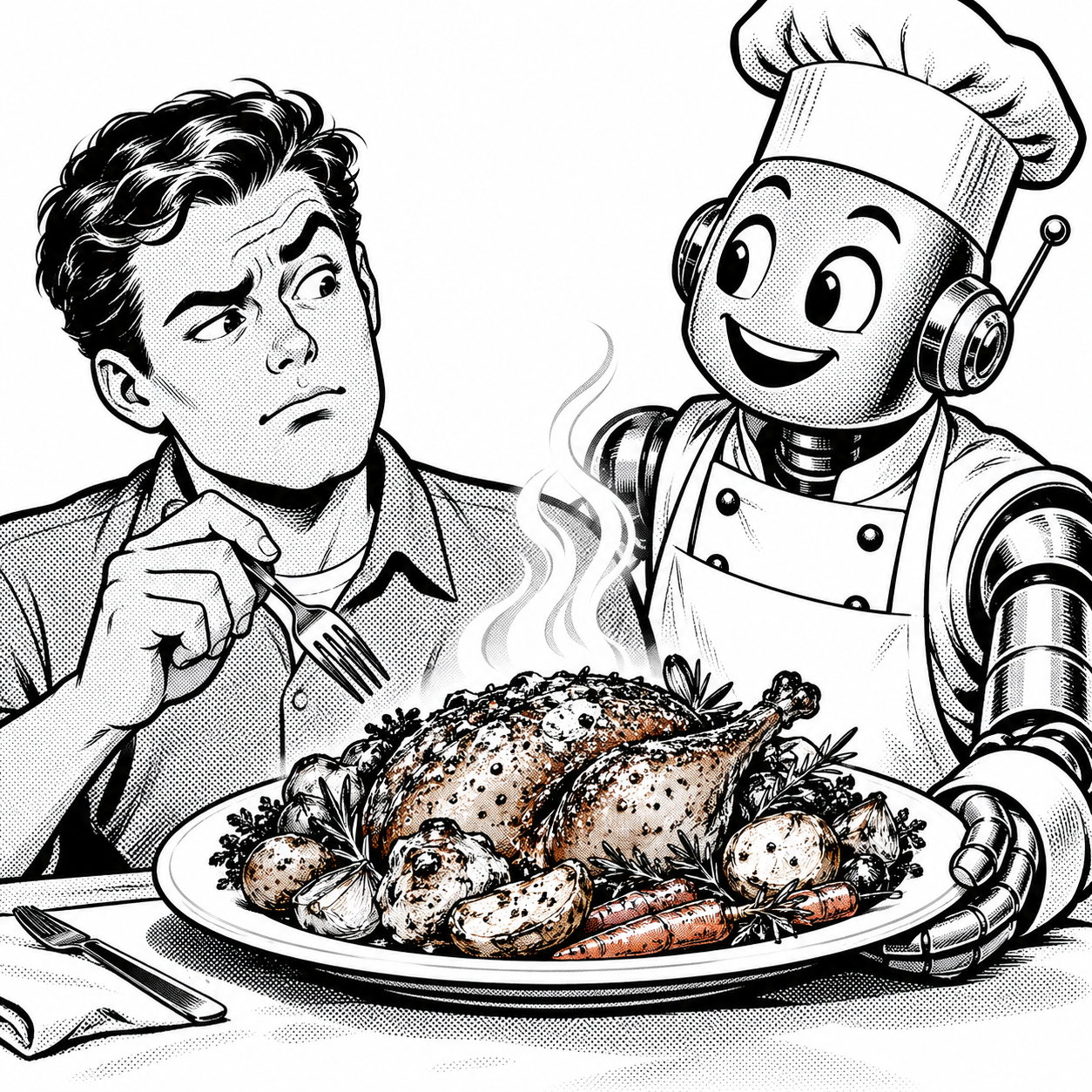
Someone comes to you with this amazing-looking dish that they've got some robot, some magic thing, to cook up. It looks tender. It looks succulent. It looks delicious.
The person bringing it to you is excited and thrilled. They can't wait for you to tuck in. But before you do, you ask them a question.
"Is it safe for human consumption?"
They think for a moment. "I don't know."
"Okay, what's in it?"
"Well, I don't really know."
"If I do like it, could you make it again?"
"I don't really know."
That's my little story for the issue with some of the things people are building with AI at the moment.
When your business starts depending on it
AI can do incredible things. I'm not trying to put much of a slowdown on, but I think there need to be some guardrails. Ideally, you or someone in the organisation needs to be able to answer these questions about whatever it is you're setting up with AI.
I'm not convinced by just having it as a black hole and thinking Claude or ChatGPT can take care of those details for me.
Short term, if you're building some cool-looking things and little tools, who cares? But when it's something that's going to become critical to your business operations, with real customer data in it, representing your company, I think knowing that information is important.
Your AI coder needs to know too
It's not just for your sake. It's important for your AI coder or agent, whatever is hooking this stuff up, building apps or doing integrations.
If it knows all this stuff and it's clearly defined, that's going to help it stay on course for the long term without going off on all these tangents.
I've seen it a few times now where it's like a house-building robot. This one's built in brick, this one in sandstone, this is wood, this is made of straw. It's just a mix, and nobody knows why.
"Well, that's just what it decided to do."
Whereas if you have some guardrails in place, you can say, "Look, we're going to build all this amazing stuff, but we use bricks and sandstone."
That's a lot easier when you think a year or two down the line, when we've got all this stuff. We know exactly what it's built in. It's all built in the same sort of raw material. That analogy does transfer into all this AI automation and software stuff.
The next person who needs to understand it
The next person who needs to know, or who it would be good to give access to this information, is a professional. Someone like me, who does software engineering and coding for a living, and connects this stuff.
If you need help, and I'm not pitching my services here, it could be from me or someone else technical. They're going to want to know what this is built in, where all this stuff is and how to find out about it. Otherwise, it is just a black hole.
I've certainly come across projects where people can't even start to answer any questions. They just don't know. So much of the project work is unpicking that.
It's fine if you're a week in. But if you're six months in and you've got this huge stack of stuff just sat there, you're trying to find out what on earth is going on and wrangle it into shape. Even though AI can do a lot of that work, moving forward with confidence becomes a little bit harder.
Answer the questions, then you can fly
That's why I recommend having me or someone else give you some guardrails, a lane to stay in with all this stuff, so you're not going out on big tangents and you can answer questions when you need to.
I've written about how AI is changing my role as a software engineer. This is part of that work. Making sure the information exists:
- Where does all this exist?
- How does it work?
- Why were these decisions made?
- Where are the backups?
- Where is the data stored?
- What do we do if we've got a problem?
Once this is answered, you can fly. You can go maximum speed, and you're going to be much better protected.
Related articles
How AI is changing my role as a software engineer
A few years ago, I interviewed for a migration contract expected to take six months. A recent project has made me realise just how much my work has changed.

Why non-developers fail at building things with AI
Why AI coding tools like Replit hit a wall at 80% completion. Learn the difference between writing code and software engineering, and why expertise still matters in the AI age.

About Joe Peel
I’m the software engineer behind HiTide. Let’s have a virtual coffee, chat about your systems and see where the conversation takes us.